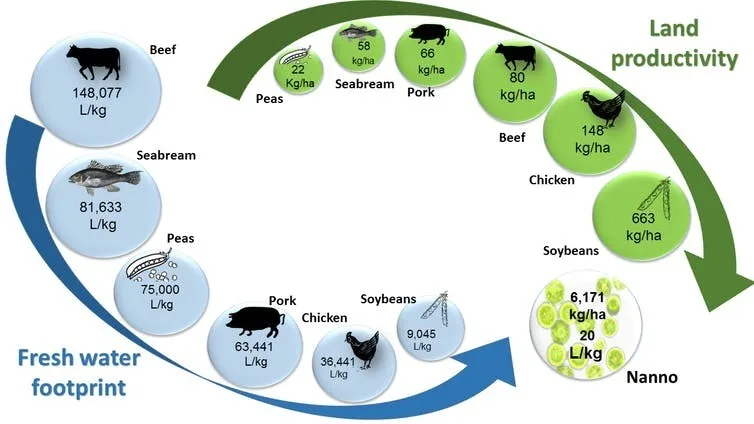
Commercial production of marine microalgae as a staple human food and feed for animals and farmed fish. These tiny organisms are the ultimate source of omega-3 fatty acids and amino acids that humans need in our diets, and which many of us get by eating fish. Microalgae are a nearly untapped resource, and are found in both freshwater and marine aquatic systems. Although they are only few micrometers in size, they produce amino acids, fatty acids, vitamins, minerals, antioxidants, polymers and carbohydrates. One sustainability metric for comparing protein production from animals, plants and marine algae is the amount of land and water needed to produce an equal quantity of essential amino acids from each type of food. We calculate that producing one kilogram of beef-sourced essential amino acids requires 148,000 liters of freshwater and 125 square meters of fertile land. In contrast, producing the same amount from an algae farm raised in an open pond with brackish water requires only 20 liters of freshwater and 1.6 square meters of nonfertile land. Credit: attn: